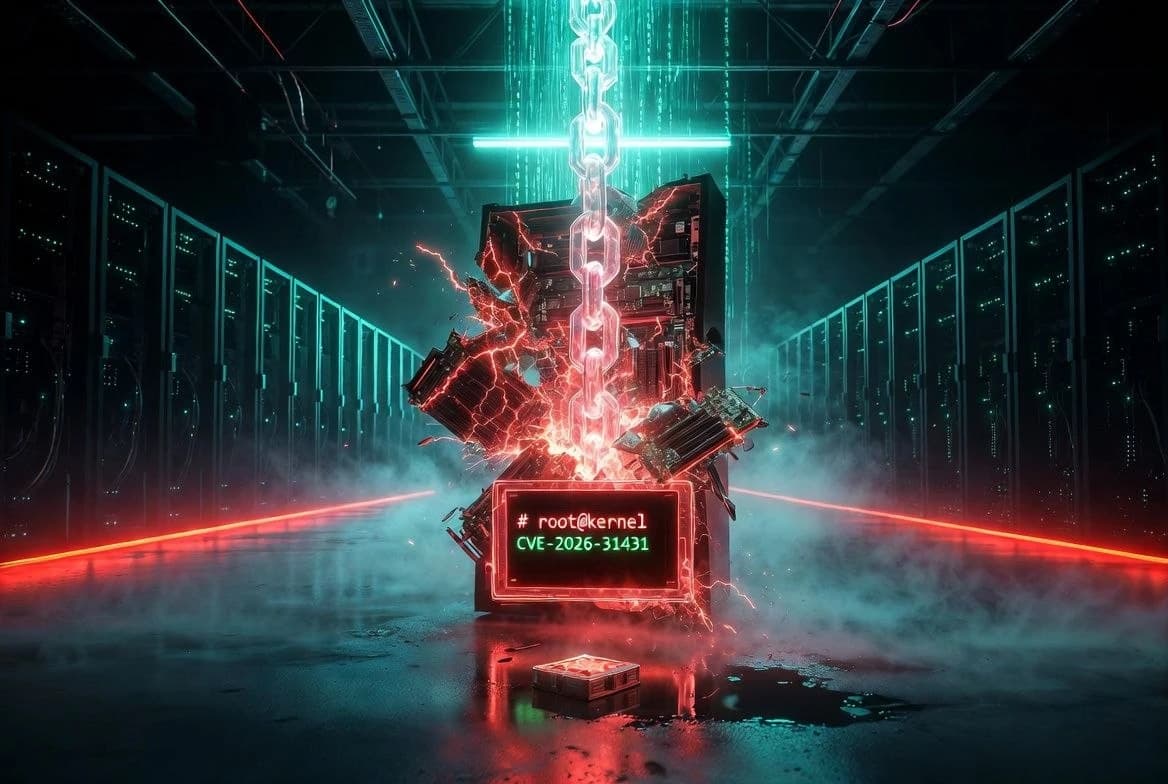

Copy Fail is a Linux bug, not a Solidity bug. That is exactly why Web3 teams should care.
CVE-2026-31431 is a local privilege escalation in the Linux kernel's crypto interface. By itself, it does not root your validator from the internet.
But realistic footholds are everywhere: SSH, a poisoned CI job, a malicious dependency, a compromised web process, a container workload. Copy Fail takes any of them to root.
In Web3, root on the wrong machine becomes deploy keys, CI secrets, validator material, frontend releases, or incident-response automation. That is protocol risk, no matter how clean the contracts are.
The kernel bug itself is not the most interesting thing about Copy Fail. The way it surfaced is. AI-assisted analysis pulled a privilege-escalation primitive out of nine years of shipping kernel code. The time between "bug class understood" and "weaponized exploit" just got shorter than most Web3 teams' patch cycles.
TL;DR
- CVE-2026-31431 ("Copy Fail"): Linux kernel local privilege escalation. Disclosed April 29, 2026. CVSS 7.8.
- It abuses the kernel crypto interface path involving
algif_aead,AF_ALG, andsplice(), corrupting the page cache backing readable files. The practical exploit path targets setuid binaries to gain root. - It is not remotely exploitable on its own. It is a post-foothold escalation primitive, and Web3 teams already face many foothold paths.
- Web3 priorities for patching: CI runners, validator and RPC nodes, deployer hosts, Kubernetes nodes, signing-adjacent machines, and frontend build/release infrastructure.
- Compensating controls: restrict
AF_ALGsocket creation via seccomp, ephemeral CI runners, isolation of signing from build, hardware-backed signing, on-chain monitoring for admin and upgrade paths. - AI-assisted analysis is in the vulnerability discovery loop now. The disclosure curve is moving faster than the patch cycle most Web3 teams plan around.
What is Copy Fail (CVE-2026-31431)?
Copy Fail is a flaw in the Linux kernel's userspace crypto API. The relevant path involves algif_aead (the kernel module exposing AEAD ciphers to userspace via the AF_ALG socket family) and the splice() syscall. The unsafe interaction lets an unprivileged local user corrupt page-cache pages backing readable files on disk. From there, the standard escalation path is to corrupt pages backing a setuid binary such as su and obtain root.
The regression was introduced in Linux 4.14 in July 2017. The vulnerable code has been shipping in mainstream distributions for nearly nine years. Sysdig's analysis says the affected range spans the 4.14 line through recent stable branches. Fixes ship in kernel images, not just kmod packages.
Major Linux vendors and downstream distributions have issued advisories, mitigations, or patched kernels. Talos Linux is affected at the kernel level, but Sidero Labs notes that the lack of interactive users, su, and setuid binaries by default reduces the practical impact on Talos hosts.
A few defensive details worth keeping straight:
- The bug is local privilege escalation, not remote code execution.
- The exploit primitive is page-cache corruption, not a memory-corruption RCE.
- The fix is shipped in the kernel image, not just the
kmodpackage. Some vendors disabled the affected module as an interim mitigation, but a full fix requires a patched kernel plus reboot or live patch. - Verify the running kernel version on each host, not just the installed package version.
We are not going to walk through exploit steps or PoC mechanics. There is enough public material; there is no benefit to adding more.
Why "local only" is not comforting
"Local privilege escalation" reads as low-priority on most enterprise dashboards. The unspoken assumption: an attacker needs a foothold first, and footholds are rare. For Web3 infrastructure, that read is wrong.
A protocol team's threat model already includes many realistic foothold paths:
- Malicious npm, PyPI, RubyGems, or Go modules pulled into a build.
- Compromised CI jobs from an upstream pull request or a poisoned dependency.
- Leaked or phished SSH keys.
- Exposed admin panels, status pages, or RPC endpoints with weak auth.
- Vulnerable web services on validator or relayer hosts.
- Poisoned Docker images consumed by Kubernetes nodes.
- Developer laptops compromised via browser or extension vectors.
- Container escape primitives chained from a tenant workload.
- Compromised contractor or vendor accounts with limited access.
Any one of these turns "local" into "already inside." Copy Fail closes the gap from "inside" to "root." And once you have root on a box that holds keys, signs releases, validates blocks, or deploys contracts, the on-chain perimeter no longer matters. (The Human Factor covers the same dynamic from the people side.)
Which Web3 hosts are at risk from Copy Fail?
Not every Linux box is equally dangerous. But Web3 teams run a specific set of hosts where root means protocol risk. Patch in that order.
| Host type | Why it matters | Copy Fail blast radius |
|---|---|---|
| CI/CD runner | Holds build secrets, registry tokens, signing material, deploy creds | Root can exfiltrate tokens, alter built artifacts, push malicious releases |
| Validator / sequencer node | Holds validator keys or network-privileged identity | Root can steal keys, tamper with binaries and config, disrupt consensus |
| Deployer host | Often holds admin keys, upgrade scripts, multisig signer access | Root can steal or substitute deployment payloads |
| Frontend build / release host | Controls the code users actually load and sign against | Root can inject wallet-drainer JS or replace bundles before CDN push |
| Kubernetes worker | Runs many tenant workloads with shared kernel | Root pivots between pods, secrets, service accounts |
| RPC / oracle / bridge node | Privileged network position, may hold relayer keys | Root can manipulate inputs, exfiltrate keys, attack message integrity |
| Monitoring / automation bot | Holds alerting, webhook, and incident-response credentials | Root can suppress alerts, race defenders, steal admin credentials |
| Signer / HSM-adjacent host | Mediates access to signing material even if keys are sealed | Root can abuse the signing channel during the attack window |
Two hosts deserve particular focus. CI runners and frontend release hosts are routinely treated as disposable build infrastructure. They are not. They are production security boundaries. If an attacker can change what gets shipped or what users sign, the contract layer is bypassed.
How does Copy Fail become a crypto incident?
Four realistic chains. Copy Fail is the privilege-boundary failure in each one.
Chain 1: CI dependency to deploy compromise. A malicious package lands in a build job and executes as the unprivileged CI user. The payload uses Copy Fail to escalate to root on the runner. Root exposes GitHub tokens, cloud credentials, registry creds, or signing material persisted on the runner. The attacker modifies an artifact, pushes a release, or reaches a deploy workflow. The contract repo is clean; the released binary is not. (Audit your release pipeline like a smart contract covers this end of the threat model directly.)
Chain 2: Web service to validator root. An attacker exploits a low-severity bug in a service running alongside a validator or RPC node and gets a low-privileged shell. Copy Fail escalates to root. From there: validator keys, modified node binaries, tampered telemetry to delay detection, lateral movement into adjacent infrastructure.
Chain 3: Frontend host to wallet-drainer. Attacker lands on a web or build host with limited privileges. Copy Fail makes them root. Root lets them modify frontend assets directly, inject drainer JavaScript, or poison deployment scripts before the next CDN push. Users hit the legitimate domain over TLS and receive malicious code.
Chain 4: Monitoring host to admin action. A monitoring or automation host gets compromised. Copy Fail escalates. Root extracts API keys, webhook secrets, and incident-response credentials. The attacker suppresses alerts during the active phase of an exploit, or uses operator credentials to authorize transactions while the on-call team is blind.
These chains are not theoretical. Many of the most damaging DeFi incidents have not been simple Solidity bugs in audited contracts. They have involved key compromise, frontend compromise, infrastructure compromise, or process failure. Copy Fail does not change that pattern. It accelerates it.
This is precisely the gap Tripwire is designed for: detecting on-chain symptoms when an off-chain compromise has already happened. The contract layer cannot tell you a CI runner was rooted last night. But admin role changes, unscheduled upgrades, and unusual deployer activity can.
The real story: AI is in the discovery loop now
Copy Fail did not surface the way kernel bugs usually surface.
Public reporting credits AI-assisted analysis tooling with shortening the path from bug class to working exploit. Don't read that as "AI hacked Linux." Read it as: a class of bug that previously needed a senior researcher and weeks of focused review surfaced faster.
And the layer it surfaced on is the deepest, most boring layer in the stack. The Linux kernel is not a JavaScript dependency. It is the floor everything else stands on. The crypto subsystem inside it has been audited, fuzzed, and stared at for nearly a decade. AI-assisted analysis still pulled a usable primitive out of it.
That cuts both ways.
On offense. AI-assisted tooling can read code at scale, hypothesize about unsafe interactions, and check those hypotheses without getting tired. Not every bug. Not magically. But the curve is moving the wrong way for defenders who assumed manual research was the natural ceiling on disclosure rate. If kernel-grade bugs surface this fast, less-scrutinized targets (node clients, bridges, oracle code, custom validator stacks) are easier game.
On defense. The same tooling is available to security teams that adopt it, including the teams reviewing your contracts and your infrastructure. (We compared the practical tradeoffs in Claude vs OpenAI for security work. Sentinel uses this kind of analysis to map privileged flows and deployment assumptions before deploy, so audits land before exploits do.)
The asymmetric risk is timing. Offense gets new tooling earlier than defense does, because offense does not need org buy-in, procurement, or a security team that already understands AI workflows. Web3 teams whose security posture assumes "we will patch when CISA tells us to" are pricing in a slower discovery cycle than the one that actually exists in 2026.
For Web3 teams, the practical implications:
- Patch windows shrink. "We will get to it in the next maintenance window" is not an acceptable posture for hosts holding keys or signing releases.
- Asset inventory matters more. You cannot patch a fleet you have not enumerated. If you cannot answer "which hosts can sign, deploy, or validate?" within an hour, that is the gap to close before the next CVE.
- Runtime controls become non-optional. Patch-only strategies assume defenders win the speed race. Sometimes you will lose. Detection and response on the on-chain side has to be sized for that case.
- AI-assisted defense is no longer optional either. If offensive research is using it on Linux internals, manual-only review is fighting a 2026 problem with pre-AI tooling.
How do I patch and mitigate Copy Fail?
Patch first, in priority order:
- Internet-facing hosts with any local user surface.
- CI/CD runners, especially long-lived shared runners.
- Kubernetes worker nodes.
- Validator, sequencer, RPC, and oracle nodes.
- Deployer and signing-adjacent hosts.
- Confirm the running kernel after reboot or live patch: package version is not enough.
Compensating controls:
- Restrict or block
AF_ALGsocket creation via seccomp profiles, particularly for containers and CI workloads. CERT-EU's advisory recommends this regardless of patch status. - Where vendor guidance allows, unload or disable the affected crypto module.
- Audit and remove unnecessary setuid binaries. Most production hosts do not need the full setuid set.
- Move to ephemeral CI runners with no persistent secrets. Long-lived shared runners are the worst case for this class of bug.
- Isolate signing and deploy from build and test. A runner that compiles code should not be able to push a release.
- Use hardware-backed signing with policy that requires explicit operator action per release.
- Monitor for unexpected privilege escalation, setuid execution, abnormal
AF_ALGsocket usage, kernel module loads, and access to sensitive files. - If a vulnerable host had untrusted local users or anomalies during the exposure window, rotate the credentials it touched.
Web3-specific controls that reduce blast radius even if a host is rooted:
- Separate signing from deployment. Different machines, different humans, different network zones.
- Timelocks and multisig thresholds on upgrade and admin paths, sized for realistic incident-response time.
- On-chain monitoring of admin role changes, upgrade transactions, deployer key usage, oracle updates, and bridge message anomalies.
- Frontend artifact integrity checks: hash, sign, and verify the bundles that hit the CDN.
- Incident-response runbooks that explicitly cover compromised CI, deployer, and validator hosts. Rehearse them. (For a recent example of process failure overriding controls, see the Delve / fake SOC 2 case.)
FAQ
What is Copy Fail (CVE-2026-31431)?
Copy Fail is a local privilege escalation vulnerability in the Linux kernel's userspace crypto API (algif_aead over AF_ALG, abused via splice()). An unprivileged local user can corrupt page-cache pages backing readable files on disk, then escalate to root by targeting setuid binaries such as su. It was disclosed on April 29, 2026 and rated CVSS 7.8.
Is CVE-2026-31431 remotely exploitable?
No. Copy Fail is not remotely exploitable on its own. An attacker must already have local code execution as an unprivileged user. The risk for Web3 teams is that realistic foothold paths (poisoned dependencies, compromised CI jobs, leaked SSH keys, vulnerable colocated services) chain naturally into Copy Fail to reach root on security-critical hosts.
Which Web3 hosts should I patch first?
In order of priority: internet-facing hosts with any local user surface, CI/CD runners (especially long-lived shared runners), Kubernetes worker nodes, validator/sequencer/RPC/oracle nodes, and deployer or signing-adjacent hosts. Frontend build and release hosts deserve the same priority as validator nodes. If an attacker can change what users sign, the contract layer is bypassed.
How do I check if my kernel is vulnerable?
Verify the running kernel version on each host (uname -r), not just the installed package version. The fix ships in the kernel image, not the kmod package, so a reboot or live patch is required. Cross-check against your Linux vendor's advisory (Ubuntu, AlmaLinux, CloudLinux, RHEL, etc.) for the patched kernel version on your distribution.
What if I can't patch immediately?
Apply compensating controls: restrict or block AF_ALG socket creation via seccomp profiles (especially for containers and CI workloads), unload the affected crypto module where vendor guidance allows, audit and remove unnecessary setuid binaries, move to ephemeral CI runners with no persistent secrets, and isolate signing from build/test infrastructure. Rotate credentials touched by any vulnerable host that had untrusted local users during the exposure window.
Where SigIntZero fits
A useful contract audit report documents the deployment and operator assumptions the code relies on. A useful protocol review goes further: CI/CD, key management, runtime monitoring, incident response. The layers that decide whether a contract bug becomes a wallet drain.
That is how we think about it:
- Sentinel (early access): AI-assisted smart contract auditing that documents the deployment, upgrade, and operator assumptions a contract relies on. The audit covers the boundary between contract and infrastructure, not just function-level findings.
- Tripwire (in development): runtime monitoring of on-chain symptoms like admin role changes, suspicious upgrades, fund movement, governance anomalies, oracle drift, and bridge message inconsistencies. Tripwire cannot prevent root on a Linux host. It can detect the on-chain consequences of one.
- Services: protocol security review beyond the contracts themselves.
If your protocol depends on Linux infrastructure that can deploy, sign, validate, bridge, or monitor funds, that infrastructure is part of your security perimeter. Talk to us if you want a second set of eyes on it.
The lesson outlasts the patch
Copy Fail will be patched across Linux fleets over the coming weeks. The underlying lesson will not.
The contract is no longer the whole perimeter. The machines that build, deploy, sign, validate, and monitor the contract are part of the protocol too. If they can change what users sign, what contracts get deployed, what validators run, or what alerts fire, they are security-critical components. Threat-model them. Patch them. Monitor them.
Audited contracts are necessary. They are not sufficient. Copy Fail is one more reason to make sure the rest of the perimeter gets the same scrutiny.
Sources and further reading:
- Ubuntu Security Notice: CVE-2026-31431 Copy Fail. Retrieved: 2026-05-25
- Sysdig technical analysis. Retrieved: 2026-05-25
- CERT-EU advisory 2026-005. Retrieved: 2026-05-25
- Tenable FAQ on CVE-2026-31431. Retrieved: 2026-05-25
- AlmaLinux notes. Retrieved: 2026-05-25
- CloudLinux notes. Retrieved: 2026-05-25
- Talos Linux response (Sidero Labs). Retrieved: 2026-05-25
- Microsoft Security Blog. Retrieved: 2026-05-25